Delivery Driver App with Route Optimization and Navigation
When planning and navigation live in one place, the day runs a lot smoother. Optiway helps delivery drivers cut wasted miles, stay on route, and keep stops moving.

Comparisons
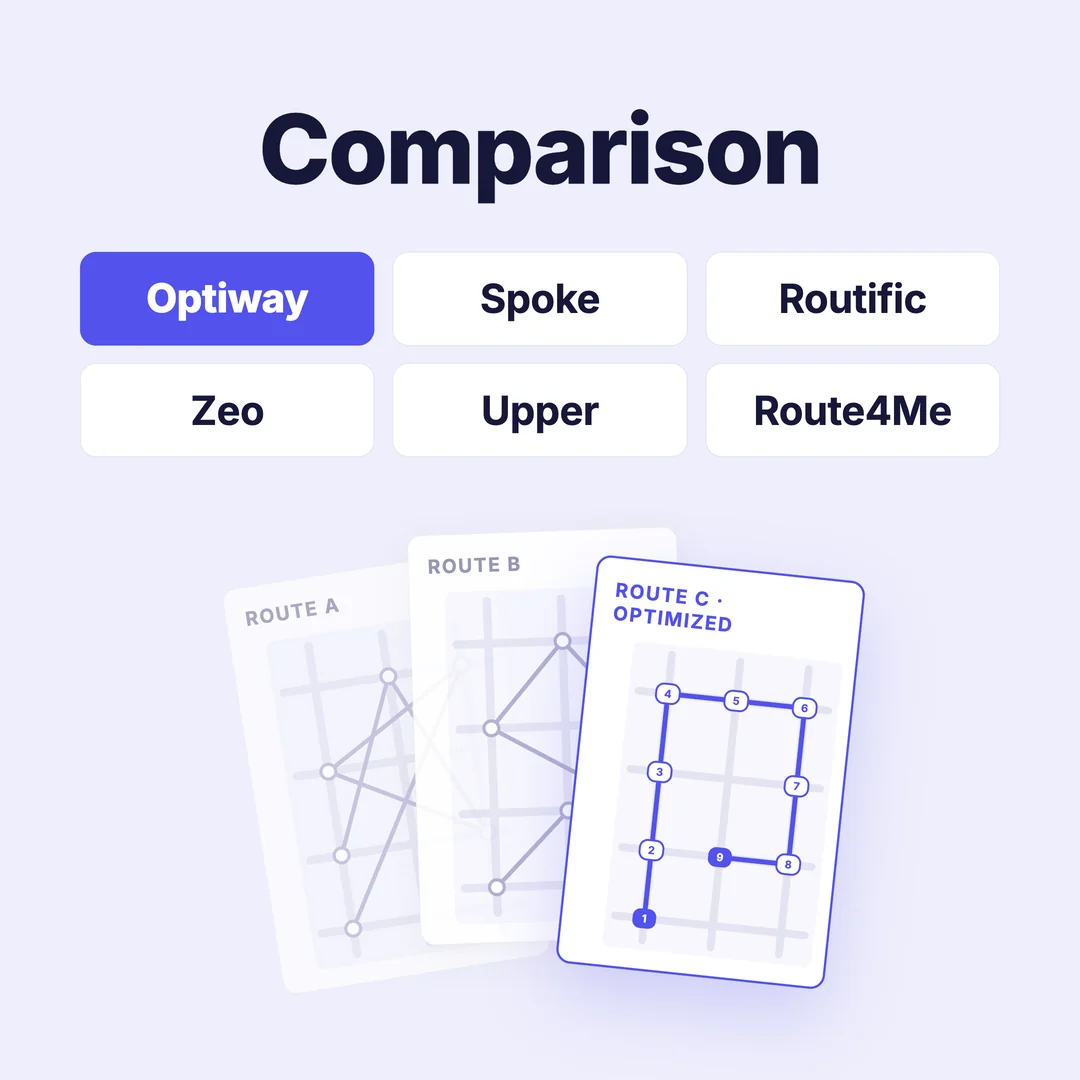
You don't need one app. You need three, and most "best apps for delivery drivers" lists quietly skip that part. A multi-stop route planner, which is what most so-called courier apps actually are, to put 80 stops in a sensible order (Spoke, Optiway, Zeo, MyWay, RoadWarrior, Upper, Straightaway, Route4Me). A navigation app to actually drive them (Google Maps, Waze, Apple Maps). A mileage tracker so the IRS hands you back 76 cents a mile instead of nothing (Everlance, Stride). And, because it comes up in every driver forum, what parcel and courier work actually pays per hour in 2026. Below: what each one costs, how many stops you get, and what each one is built around. Prices checked October 2026.
Spoke is the best all-round route planner app for delivery drivers in 2026: 10 free stops, from $9.99 a month, 4.7 stars from 11,000 ratings, and the one everybody at the depot already uses. Past that, the best delivery app for drivers depends on your day: MyWay if you need proof of delivery for the least money, Straightaway if your day starts with a stack of parcels and $9.99 is your ceiling, Optiway if your stops show up as a file or on paper labels and you need proof of delivery with them, Route4Me if you want unlimited stops for $9.99 from the oldest name in the business. All eight reorder your stops, which Google Maps still won't do, and all eight run on iPhone and Android.
| App | Paid from | Stops per route (paid) | Stands out for |
|---|---|---|---|
| Spoke (ex-Circuit) | $9.99/mo | Unlimited | In-app navigation on every paid plan; voice, camera and time windows on Standard |
| Optiway Route Planner | $19.99/mo | 200 | AI address recognition from any document; priority stops; PDF or Excel day report |
| Zeo Route Planner | $15.99/mo | Unlimited | Customer ETAs, proof of delivery, mileage tracker on the paid plan |
| MyWay Route Planner | $9.99/mo | 200 | Import from photo, voice, file or contacts; proof of delivery; 4.8 stars |
| RoadWarrior | $15/mo | 200 | FedEx and OnTrac manifest upload, time windows |
| Upper Route Planner | $19.99/mo | 500 | 500 stops per route, paper list scanning, proof of delivery |
| Straightaway | $9.99/mo | 250 | Photo of a manifest to a 250-stop route, built-in navigation |
| Route4Me | $9.99/mo (driver app) | Unlimited | Voice navigation in-app, proof of delivery with video, 12K ratings |
Prices are the US prices shown on each vendor's pricing page or App Store listing on 28 October 2026, before tax. App Store and Google Play prices differ by country, so the figure in your store may be higher or lower. Free plans and their stop limits are described in each app's section below.
Spoke, the renamed Circuit Route Planner, is the best all-round route planner app for delivery drivers: 10 free stops per route, then Lite at $9.99 a month or Standard at $19.99 ($119.99 a year), and the most-installed app in this list with 4.7 stars from 11,000 ratings in the US App Store. Both paid plans remove the stop limit and include Spoke's own navigation; Standard adds spreadsheet import, voice and camera entry, arrival time windows and package location. It's the safe pick if you don't need proof of delivery.
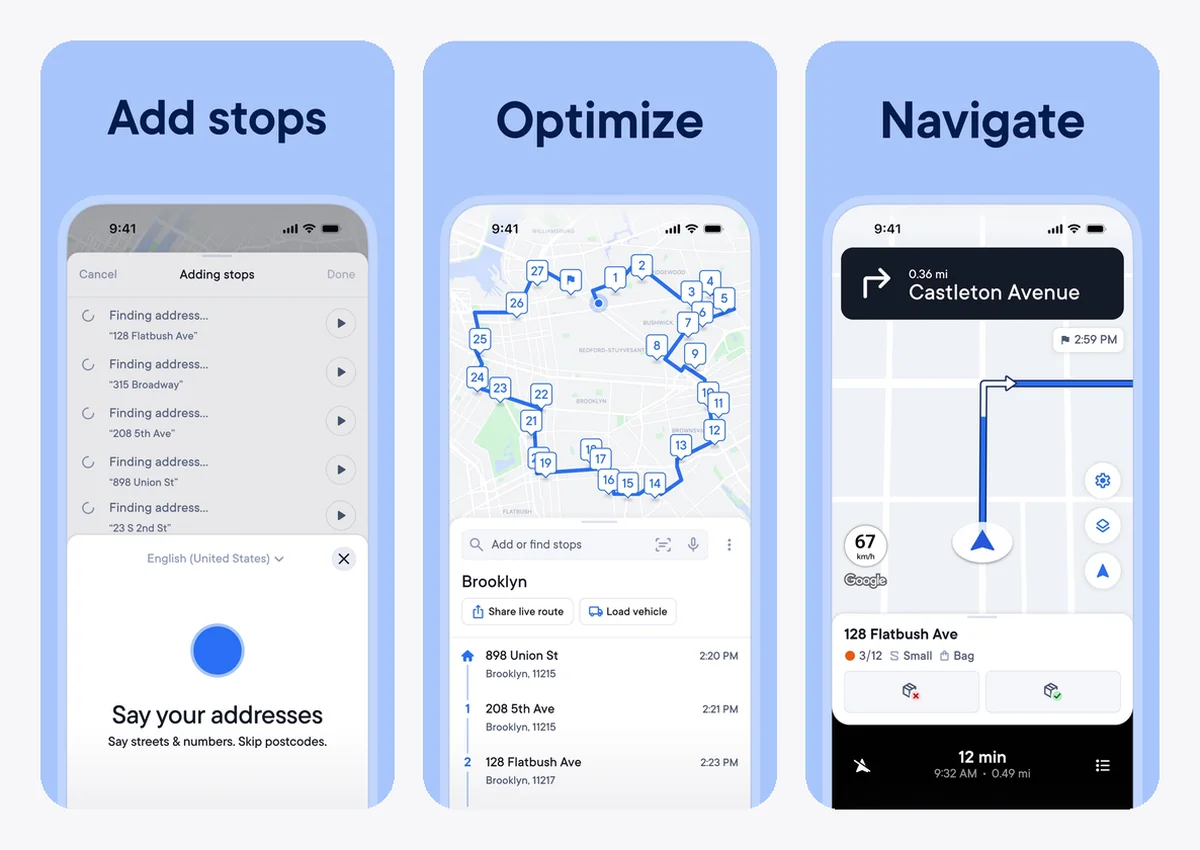
What it does well, by its own plan comparison: turn-by-turn navigation built into the app on Google's map data with live traffic alerts, on Lite as well as Standard, and you can switch to Apple Maps, Waze, HERE WeGo or Sygic in settings; on Standard, stops go in from a spreadsheet, by voice or by pointing the camera at printed text, every stop can carry an arrival time window, an urgent stop can be made the next one or pinned to the start or end of the route, and each stop takes custom properties, notes, a Stop ID and a vehicle load location so finding a parcel later is easier. Spoke's pricing page lists CarPlay and Android Auto. If your van has a screen, that alone is worth the money.
The catch: 10 free stops won't get you through a real morning, and on Lite you type every address by hand with no time windows, so the plan most drivers actually want is Standard at $19.99. Proof of delivery isn't in the driver app at all. Spoke keeps that for Spoke Dispatch, its team product, which starts at $125 a month. Need photos or signatures as a solo driver? Look at MyWay or Optiway.
Optiway Route Planner is best for delivery drivers whose stops arrive as a document from a client or as paper labels on the parcels, up to 200 stops per route for $19.99 a month: drop in any file with addresses in it, a spreadsheet, a CSV or a plain text list, and the AI works out the layout on its own with no template to match, or point the camera at the labels, and you get a route of up to 200 stops with time windows and priorities. There's one paid plan, Pro, at $19.99 a month (US price, your store may differ), with the full 200 stops and every feature, and it starts with a free trial with no limits — 3 days on iPhone, 7 on Android. Run one real delivery day on it before the first charge. On the App Store since January 2023, on Google Play since 2026.
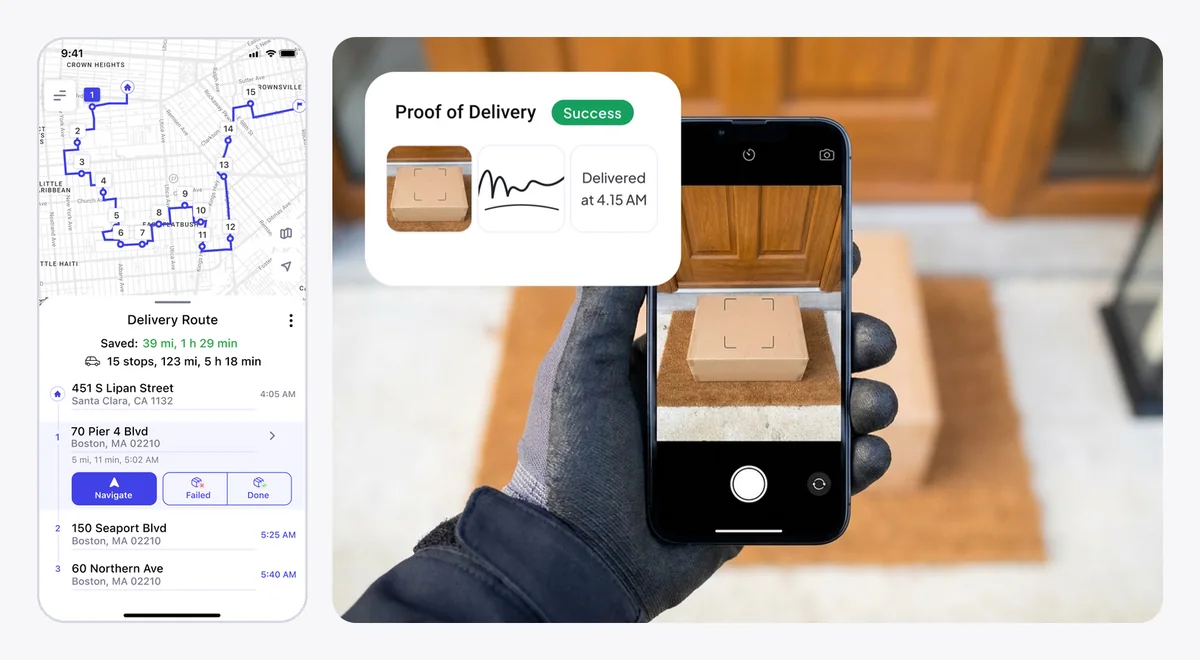
What it does well: the AI import works out the structure of whatever document you hand it, even one with mistakes in it or laid out nothing like our sample, pulls the addresses out and shows you which ones it couldn't place before anything lands on the map, the camera scanner reads a printed address straight into the stop list, you can also dictate an address or drop a pin on the map, you get time windows, priority stops and proof of delivery with a photo, a signature or a note, any stop can be made the next one mid-route, and you can reorder stops by hand and skip optimization altogether, each leg hands off to Apple Maps, Google Maps or Waze, and the finished day exports as a PDF or Excel report.
The catch: no CarPlay or Android Auto yet (both are on the roadmap), and navigation hands off to Google Maps, Apple Maps or Waze rather than running inside the app, the same as MyWay and Upper. And there's no cheaper cut-down plan: where Spoke sells Lite at $9.99 and Route4Me a Basic plan, Optiway has Pro only, so $19.99 is the entry price, level with Spoke Standard, Upper and Route4Me Enhanced.
Zeo Route Planner is best for drivers who want a mileage tracker inside the planner: 12 free stops per route, PRO $15.99 a month. PRO at $15.99 a month, $4.99 a week or $129 a year (7-day trial) unlocks four things: unlimited stops, scanning a photographed list of addresses into stops, a mileage tracker for taxes, and route history older than a month. What Zeo leads with: real-time ETA updates for customers, proof of delivery on each stop, a time-at-stop per address (but no time windows), delivery or pickup stop types, and stop entry by search, map pin, Excel import or voice. 4.5 stars from 361 ratings. The catch: no time windows at all, so a stop with a delivery promise has to be placed in the route by hand; and scanning, mileage tracking and routes older than a month all sit behind PRO.
MyWay Route Planner is best for your first week of multi-stop driving, when you want nothing to configure: 15 free stops with proof of delivery, $9.99 a month after that, and the best rating here, 4.8 stars from 2,300 ratings. Its pitch is speed of entry: addresses come in by photo, voice, Excel, CSV, your contacts, a web link or Google Drive and Dropbox, then optimize or keep your own order, then one tap to open each stop in Google Maps, Apple Maps or Waze. Proof of delivery with photos, a signature and notes, a time window and time-at-stop per address, and priorities from first to last are all included. 15 free stops per route with every feature, then $9.99 a month or $79.99 a year for routes up to 200 stops. The catch: no built-in navigation (a Live Widget gives step-by-step hints on top of your maps app instead), and the team features are still "coming soon".
RoadWarrior is best for FedEx and OnTrac contractors: 8 free stops, Pro $15 a month for up to 200 stops, and one product from solo driver to dispatched fleet. It uploads their manifest files directly, takes addresses from search, your contacts or a tap on the map, bulk-uploads lists, and supports an availability time window per stop. Navigation used to mean handing off to Apple Maps, Waze or HERE; a February 2026 update added turn-by-turn inside the app. 4.6 stars from 7,500 ratings. Free Basic gives you 8 stops per route; Pro is $15 a month, or $10 a month billed $120 a year, and syncs two devices. The catch: no proof of delivery, only check-ins with a time stamp at each stop, and RoadWarrior's own pages disagree on the Pro stop ceiling, 200 per run on the homepage against 120 in its support article, so check inside the app before you plan a 150-stop day on it.
Upper Route Planner is best for drivers who want the biggest single route: 500 stops per route for $19.99 a month, with a 3-day trial. Upper's driver app, "the route planner app that gets you home earlier", leads with stop entry by typing, pasting from a spreadsheet, CSV, voice or scanning a paper list, one-tap optimization by time or by miles, a hand-off to Google Maps, Waze, Apple Maps or MapQuest for the driving, proof of delivery with photo or signature, and reports on completed routes. It costs $19.99 a month or $189.99 a year with a 3-day free trial and no free plan. The catch: that puts it at the top of the price range with Spoke Standard, Optiway Pro and Route4Me Enhanced, and the weekly price reads $9.95 on Upper's site and $4.99 in the App Store, so check your store before you believe either.
Straightaway is best for the gig driver who starts the day holding a stack of parcels and no list: 25 addresses free, then $9.99 a month for up to 250 stops. Its whole pitch is "plan your route in seconds": photograph the manifest or the labels, 150 stops in under two minutes, up to 250 stops in optimal order, with built-in turn-by-turn navigation that watches traffic, road closures and weather. The free plan reads 25 addresses; Pro is $9.99 a month or $95.99 a year. The catch: the free plan also caps turn-by-turn navigation at 10 hours, and at the time of writing the App Store listing hadn't been updated for over a year (4.2 stars, 513 ratings).
Route4Me is best for drivers who may grow into a fleet: unlimited stops for $9.99 a month, in the stores since 2009, 4.6 stars from 12,000 ratings, "trusted by professional drivers for 10+ years". The app leads with address entry by search, voice, camera scan or list upload, one-tap optimization, voice-guided turn-by-turn navigation inside the app, a route engine that "fixes it on the fly" when something goes wrong, and proof of delivery with photos, video, notes and signatures. The free plan gives you 10 stops per route (those routes vanish after 7 days), and Basic at $9.99 a month or $79.99 a year removes the stop limit entirely, which at that price only Spoke matches. The catch: the app is a cut-down version of Route4Me's fleet platform, so the menus are built for dispatchers first, and marking a stop as visited or adding a note to it sits in the $19.99 Enhanced plan.
Google Maps is the best navigation app for most delivery drivers, Waze for dense city traffic and Apple Maps if you drive on CarPlay all day, but none of the big three plans a delivery route. We're willing to bet you already knew that, but it's worth saying once: Google Maps lets you add up to 9 stops after your start and drives them in the order you typed them. Google Maps Help explains how to drag stops around by hand, and that's the whole "optimization". Waze wants one destination at a time; its trick is rerouting around traffic and police, which matters on a city run. Apple Maps has done multi-stop routes since iOS 16, also without reordering, and it's the smoothest option if you drive all day with CarPlay on the van's screen.
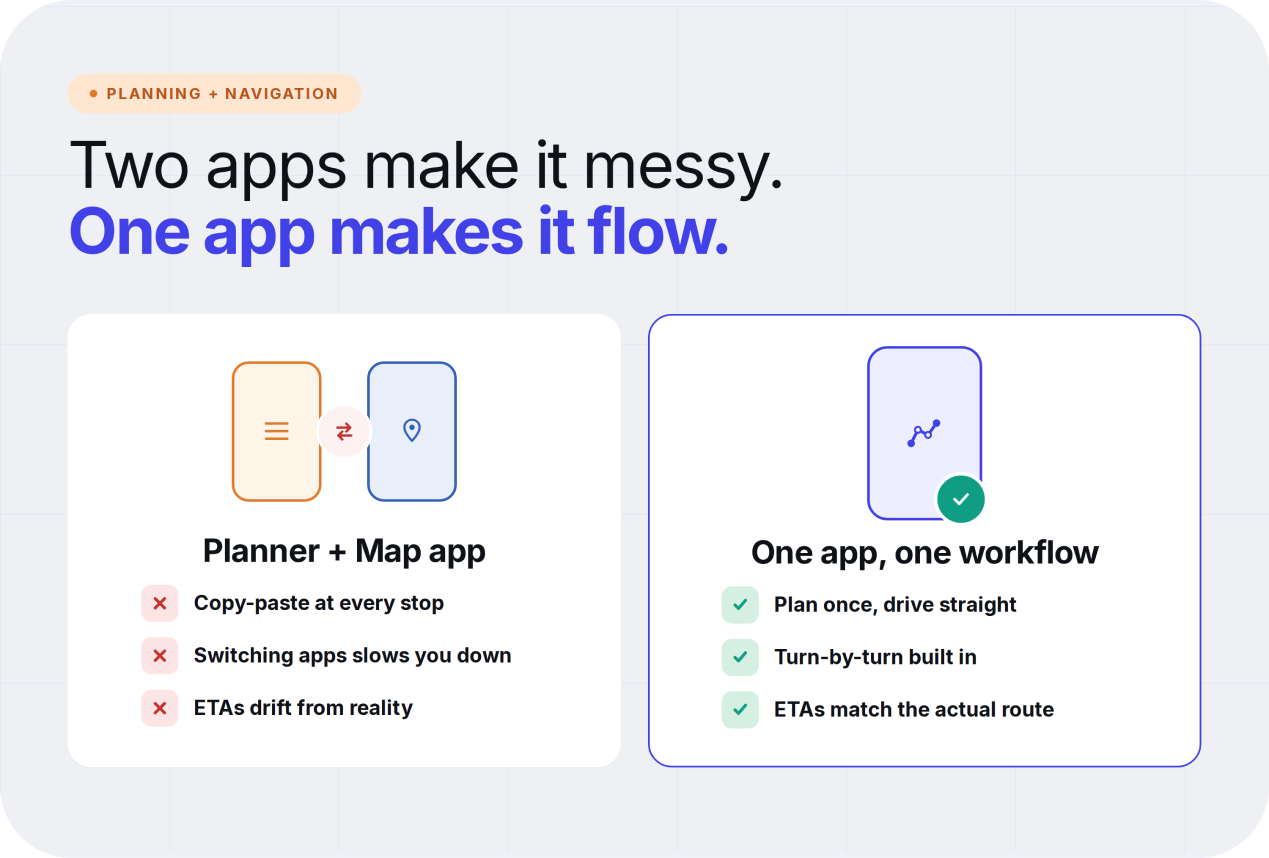
So the setup most drivers land on (we broke it down in delivery driver app with route optimization and navigation): build and reorder the day in a planner, then either navigate inside it or tap "navigate" on each stop and let Google Maps or Waze do the driving. Spoke, RoadWarrior (since a 2026 update), Straightaway and Route4Me have turn-by-turn navigation built in; MyWay, Upper and Optiway hand each stop to Google Maps, Waze or Apple Maps, which is still the more common setup. Spoke is the one that also lists CarPlay and Android Auto, which is worth the fee if your van has a screen.
Which one wins depends on your route. If you deliver to new developments or rural addresses that half the apps can't find, Google Maps usually has the best address database. If you work a big city at rush hour, Waze will save you the most minutes with its live rerouting. If you drive an iPhone with CarPlay and don't want a second app on the dashboard, Apple Maps is the simplest. And it depends on where you drive: map data is refreshed at different speeds in different countries, Apple Maps is strongest in the US and Western Europe and patchy elsewhere, and Waze only knows about a closed road if enough local drivers reported it, so it shines in big cities and goes quiet in small towns. Try two of them on the same route for a week before you commit the whole van to one.
Stride (free) and Everlance (free tier, about $9 a month) are the two mileage tracker apps delivery drivers use most, and the reason is money: if you're self-employed in the US, every business mile you drive in 2026 is worth 72.5 cents off your taxes from January to June and 76 cents from 1 July, under the IRS standard mileage rates. Drive 25,000 business miles a year and that's roughly $18,500 of deduction. A log that survives an audit is not a nice-to-have. Two apps do it for free or close to it:
Where both bite: automatic detection chews through battery on a long shift and now and then merges two short drops into one trip, so skim the log once a week while you still remember the day. And no, a route planner isn't a substitute. Optiway and most of the others export the planned route, not the miles you actually drove, and the IRS wants the actual ones. The exception is Zeo, whose paid plan includes a mileage tracker, which saves you a second app if you already pay for it.
How much do delivery drivers make? About $19 to $28 an hour in 2026: $21.57 median for all US light truck and delivery drivers, $18–25 on Amazon Flex, $19–32 at FedEx, and which end you land on depends on whose parcels you carry. If you're weighing where to drive rather than which app to use: parcel work pays better than the food apps, and it's also the only kind of driving where a route planner earns its keep. Here is what the public numbers say about delivery driver earnings in 2026, from Amazon Flex pay to FedEx Ground driver pay and the average courier salary, all gross, before fuel, insurance and self-employment tax:
| Where you drive | Pay per hour (gross) | Source |
|---|---|---|
| Amazon Flex pay (your own car, 2–4 hour blocks) | $18–25 by Amazon's own estimate; $22.60 average in Gridwise data | flex.amazon.com; Gridwise 2026 Annual Gig Mobility Report |
| Amazon DSP driver pay (employee of a delivery partner, Amazon van) | almost $22 average projected by Amazon, up 7% year on year | Transport Topics |
| FedEx Ground driver pay (employee of a contractor) | $19–28; contractor routes vary with stop count | Gridwise, March 2026 |
| FedEx Express courier | $20–32 | Gridwise, March 2026 |
| Courier salary, all US job postings | $19.22 average base pay across 1,700 postings | Indeed, October 2026 |
| Light truck and delivery drivers, all employers | $21.57 median | BLS 2025 wage data via O*NET |
For comparison, Gridwise's 2025 medians for the food and grocery apps run from $11.26 an hour on DoorDash to $15.38 on Grubhub, and those jobs hand you one or two orders at a time, so a route planner changes nothing there. And all the figures above are gross: Gridwise also found that by March 2026 fuel alone ate 15.6% of delivery drivers' gross, before insurance, maintenance and self-employment tax. Sources for the table: Amazon Flex, Transport Topics, Gridwise on FedEx pay, Indeed, O*NET.
Where a route planner comes in: Amazon Flex blocks, FedEx Ground and OnTrac routes, and courier runs for local shops hand you 30 to 150 parcels at once, and the block or the route pays the same whether you're done in three hours or four. That spare hour is the planner's whole value, and it's why Straightaway, RoadWarrior, Spoke or Optiway can charge for it.
The sign you've outgrown a route planner app isn't a driver count. It's the morning one person starts collecting everyone's addresses, splitting them by hand and sending each driver a screenshot of their route in the group chat. We're willing to bet you've seen that morning. At that point you want dispatch software (dispatching vs routing draws the line between the two): one place where the stop list gets split between drivers, a map that shows where each van is right now, and proof of delivery and ETAs that reach the customer without anyone forwarding a photo. Five of the vendors above sell a tool like that for small teams, and they charge for it in two different ways: per stop with unlimited drivers, or per driver seat:
| Tool | How you pay | Starting price | Free plan | Best for |
|---|---|---|---|---|
| Spoke Dispatch (ex-Circuit for Teams) | Per stop, unlimited drivers | $125/mo for 1,000 stops | Trial only | Teams whose drivers already use Spoke |
| Routific | Per order, unlimited drivers | $150/mo for 1,000 orders | 100 orders a month | Teams that want balanced routes and reports from day one |
| Optiway Dispatch | Per stop, unlimited drivers | $99/mo for 2,000 stops (Team plan) | 300 stops a month (Early Access) | Teams whose drivers already run the Optiway app, or want to try dispatch on a real day without a contract |
| Upper Crew | Per user seat | $50/user/mo (Starter: 250 stops per route, 10 driver profiles) | 7-day trial | Teams that already route in Upper and want a desktop planner from the same vendor |
| Zeo Fleet Management | Per driver seat, billed quarterly or yearly | $599/yr per driver (about $50/mo) | 7-day trial | Teams that need API, webhooks and recurring routes on day one |
Spoke, Routific and Optiway let you add every driver at no extra cost; Upper Crew and Zeo Fleet still charge per seat, which looks cheap for two drivers and stops looking cheap at six. Optiway Dispatch is the newest of the five: it launched in 2026, there's no public API yet, and integrations get set up on request rather than self-serve, so if you need Shopify, Zapier or webhooks today, Routific, Spoke or Zeo are the safer bet. Here's what dispatch software does in more detail, and Optiway Dispatch if you want to see the board. Early Access is free for 300 stops a month (here's what free dispatch software actually includes), so you can run tomorrow's stops through it and decide.
The best delivery app for drivers is the one that fixes what bites you most, not the one with the longest feature list. If you want the fewest taps between a list of addresses and a phone that's already navigating, Spoke or Straightaway. If proof of delivery matters more than anything else and $9.99 is your ceiling, MyWay. If your stops arrive as a spreadsheet, a CSV, a stack of labels or a list you'd rather dictate, and you want to reorder the route yourself and collect a signature at the door, Optiway. If you run one carrier's route of 150+ stops and want navigation that never leaves the app, Spoke, RoadWarrior or Straightaway. If you're counting every dollar, Route4Me at $9.99 or Spoke Lite.
Whichever you pick, test it the same way: one normal day, your real stop list, the free tier or the trial. The only numbers that matter are yours: minutes from list to first stop, addresses it got wrong, and whether you got home earlier. And if the question in your head is about your drivers rather than your own route, skip the solo apps and start with the dispatch section above.
Straightaway gives the largest free route, 25 addresses, and MyWay gives 15 stops with proof of delivery included. Zeo gives 12, Spoke and Route4Me stop at 10, RoadWarrior at 8. If your typical day has more than 25 stops, no free plan covers it, and the cheapest paid options are MyWay, Straightaway and Route4Me Basic, all at $9.99 a month.
The same planners work as a courier app for drivers in the UK, with UK addresses and postcodes: Spoke, MyWay, Zeo and Optiway all list UK pricing in their stores. For parcel couriers working for Evri, DPD or Amazon Flex UK, the best courier route planner app is one with a label scanner (Straightaway, Optiway), because the stop list arrives on the parcels, not in a file.
For the driving, yes; for the planning, no. Google Maps lets you add up to 9 stops after your start point and drive them in the order you entered; you can drag stops to reorder them by hand, but it will not calculate the shortest order. Every app in this article does that calculation (more in Google Maps alternative for delivery route planning), then hands each leg back to Google Maps, Waze or Apple Maps for the driving.
Most of them now do. Straightaway built its whole app around photographing a manifest or labels (25 addresses free, then paid); Spoke (Apple Live Text, Standard plan), Zeo (PRO plan), MyWay and Route4Me add stops from a photo, a scan or your voice; Optiway scans printed addresses with the camera one stop at a time and keeps proof of delivery in the same app; Upper scans a paper list. Spoke's "locate packages" is different: it tells you where a parcel is in the van, it does not read the label.
By the independent numbers, Amazon Flex: $18–25 an hour by Amazon's own estimate and $22.60 on average in Gridwise data, against $11–15 medians for DoorDash, Uber Eats, Instacart and Grubhub. Parcel work pays more because you carry 30 to 150 packages per block, and that is also where a route planner turns an hour of driving back into pay.
FedEx Ground drivers employed by a contractor earn $19–28 an hour and FedEx Express couriers $20–32, by Gridwise's March 2026 figures; contractor routes are paid per route, so the hourly rate rises or falls with the stop count. Both sit above the $21.57 median for all light truck and delivery drivers.
Amazon's own estimate is $18–25 an hour; Gridwise puts the 2025 average at $22.60. Blocks run two to four hours and pay a fixed amount, so a 30-to-150-parcel block finished early is where a route planner directly raises your hourly rate.
It depends on how your stops arrive. If they come as labels on the parcels (Evri, DPD, Amazon Flex), Straightaway or Optiway, which both read them with the camera. If your depot hands you a FedEx or OnTrac manifest, RoadWarrior imports it directly. If everyone at your depot already runs Spoke, Spoke, because the stop lists and tips travel with the crowd. If the stops come as a document from a client, Optiway reads any file. No single courier route planner app wins for every courier; the table at the top puts the limits and prices side by side, and route planner app for independent couriers goes deeper on the self-employed case.
Delivery Driver App with Route Optimization and Navigation
When planning and navigation live in one place, the day runs a lot smoother. Optiway helps delivery drivers cut wasted miles, stay on route, and keep stops moving.
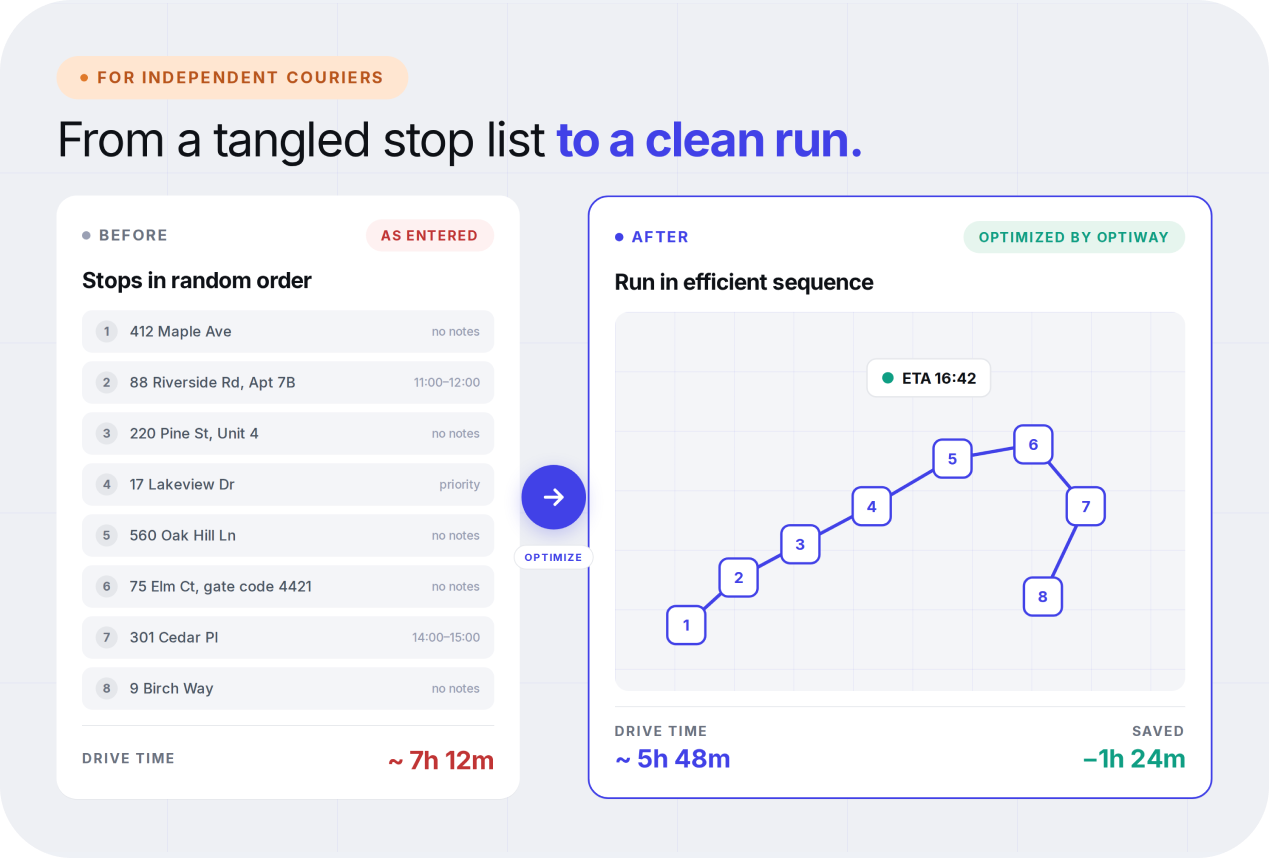
Route Planner App for Independent Couriers with Multiple Stops
Too many stops can turn a simple shift into wasted miles and late arrivals. Optiway helps independent couriers plan smarter routes and keep the day under control.
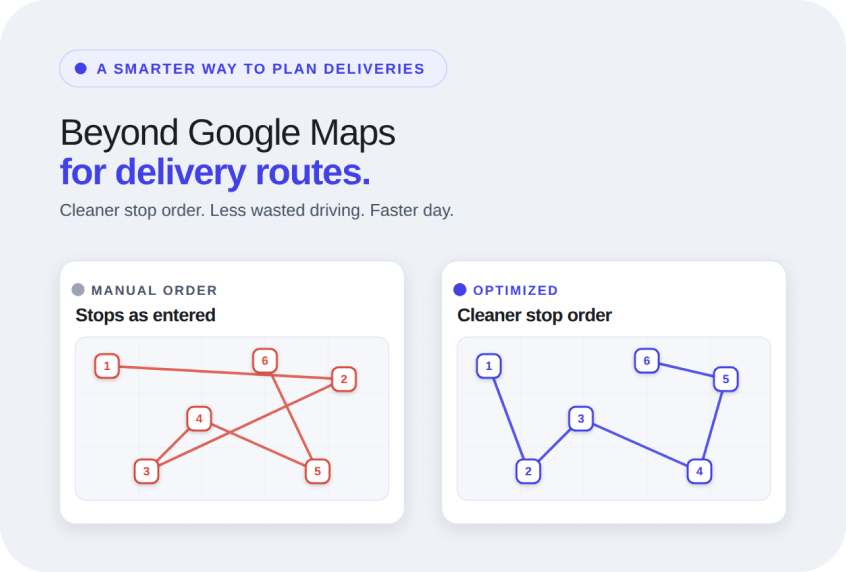
Google Maps Alternative for Delivery Route Planning
When Google Maps starts slowing down your delivery day, Optiway gives local delivery businesses a cleaner way to organize stops, improve route order, and keep the day moving.
Plan, assign and track every driver — live, from one dashboard.