How to Keep Groceries Fresh on a Route With Multiple Stops
Milk, meat, frozen items, and too many stops can ruin a run fast. Optiway helps shape cleaner grocery routes so freshness lasts with less backtracking.

Delivery & Couriers
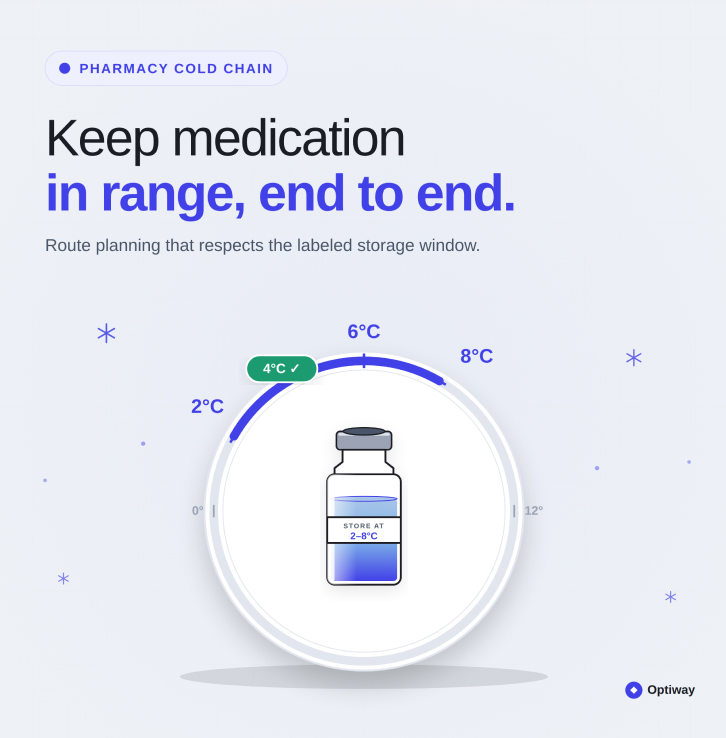
If you are working out how to plan a pharmacy route for temperature-sensitive medications, the route itself has to support the cold chain from the first packed box to the final handoff. Many pharmaceutical products must stay within labeled storage conditions to preserve safety, purity, potency, and overall effectiveness. Time- and temperature-sensitive pharmaceutical products can degrade when they are not kept within predefined environmental conditions or time limits during storage or transport.
That is why route planning for pharmacy deliveries is not just about shaving miles off the map. It is about limiting avoidable exposure. A few extra detours, a poorly ordered stop list, or a long wait between handoffs can push sensitive products closer to a temperature excursion. Drugs need to be transported, handled, and stored in a way that reduces the risk of exposure to temperatures outside their labeled conditions, while transport conditions should match product stability needs and route requirements.
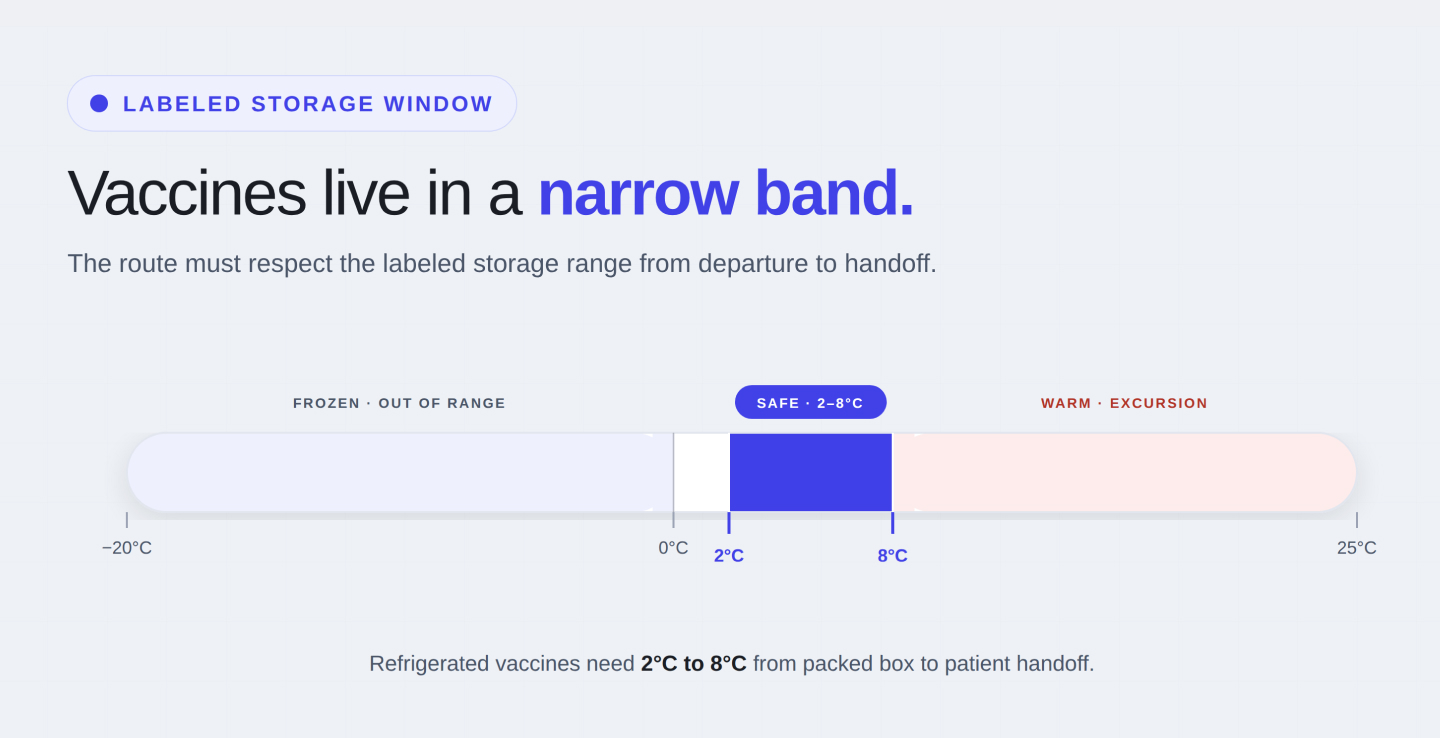
Every pharmacy route should begin with the storage instructions attached to the medication, not with a generic rule of thumb. Biological products need the specific storage conditions listed in their product labeling, and some products have narrow temperature ranges. Many refrigerated vaccines, for example, are kept at 2°C to 8°C, while some products require frozen storage and can lose potency if exposed to the wrong temperature band.
In practical terms, that means you do not plan one broad “medical route” and hope everything on it behaves the same way. You plan a route that respects the most sensitive products on board. The tighter the allowable range, the less room there is for wandering stop order, long idle gaps, or unnecessary handling before departure. That is the heart of how to plan a pharmacy route for temperature-sensitive medications: the medicine sets the timing rules first, and the route follows.
The route clock should start as late as possible. Temperature-sensitive medications should stay in qualified storage until the route is packed, checked, and ready to leave. Temperature-controlled storage, calibrated monitoring devices, and correct packing procedures all help maintain the specified temperature range before and during transport.
This is where small operational habits matter. If a package is packed too early, moved too often, or left waiting while the route is still being organized, the safety margin shrinks before the first stop even begins. Because these products are limited by both time and temperature, the route should be built so loading happens close to departure, with the sequence already decided and the least stable products protected from wasted time on the dock or in the vehicle.
On a pharmacy route, stop order is not a cosmetic detail. It determines how long each medication stays in transit. The route should be arranged to cut unnecessary dwell time, backtracking, and repeated handling, while keeping temperature-sensitive products inside the most predictable part of the run.
The cleanest approach is to place the most temperature-sensitive deliveries where they can be completed within a controlled, predictable portion of the route. Time-critical stops should not be buried behind avoidable loops. If a product has a narrow temperature tolerance or a tight patient availability window, that stop deserves a sequence that keeps transit shorter and handoff faster. This is not a separate compliance layer tacked on after the fact. It is what proper route planning looks like when medicine quality is part of the route design.
Insulated packaging, cooling media, and in-transit monitoring need to be chosen for the route before dispatch. Shipping containers should protect the product against expected ambient temperatures in transit and should be packed in the specified configuration needed to maintain the correct temperature range. Freeze-sensitive products also need protection from temperatures below 0°C when frozen packs are used.
That changes the way route planning should be approached. The route is not only about addresses. It is about how long the packaging can safely hold conditions on that run. If the lane is longer, warmer, or more stop-heavy, the packout has to match that reality. A pharmacy route planned without regard to packaging duration is only half planned. The route and the thermal protection need to agree with each other before the vehicle leaves.
Temperature exposure should be monitored during distribution with suitable tools such as freeze indicators, electronic loggers, alarms, or other indicators. Indicator status should be checked and documented on arrival, and transit temperature records should be stored when monitoring devices are used.
That matters because packaging alone does not tell you what happened inside the box over the whole run. A route can look tidy on paper and still be undermined by an unexpected delay, a prolonged parked period, or exposure during loading and unloading. Monitoring closes that gap. It tells you whether the route protected the medication in practice, not just in theory.
Shipping containers should be handled in a way that minimizes mechanical damage, contamination, light exposure, and tampering risks during transit. That is one reason route order should be tied to load order whenever possible. A package that has to be repeatedly shifted around inside the vehicle is exposed to more handling than it needs.
For pharmacy deliveries, that usually means arranging the load so each stop can be reached with minimal searching and minimal time with the container open. Even when the storage equipment is doing its job, repeated access creates more opportunities for temperature drift and handling mistakes. The smoother the handoff sequence, the better the route supports product integrity from start to finish.
For route planning, the useful part is turning a stop list into a cleaner sequence before the run starts. Optiway’s pharmacy delivery route planner is built for multi-stop route optimization with stop-by-stop sequencing, ETAs, time windows, mobile access, delivery notes, and simple route updates when urgent prescriptions are added. Those features matter for pharmacy work because they help reduce messy stop order, cut back on unnecessary circling, and make the route easier to execute in the order it was planned.
Optiway can help pharmacy teams plan tighter runs for temperature-sensitive medications by making expected timing clearer before drivers leave. The goal is not to layer more complexity onto the route. It is to remove the avoidable disorder that stretches transit time and makes careful cold-chain handling harder than it needs to be. When the sequence is tighter and the expected timing is clearer, temperature-sensitive products have a better chance of arriving inside their required conditions.
Even a well-built route needs a fallback plan. Contingency planning should cover equipment failures, refrigeration or freezer unit issues during transit, unexpected delays, and temperature excursions. If an excursion happens, it should be investigated promptly, documented, and reviewed according to internal procedure and product-specific requirements before any decision is made about the affected medication.
So the route plan should answer a few hard questions before anything leaves the pharmacy. What happens if the container fails? What happens if a stop runs long? What happens if monitoring shows an excursion on arrival? The right answer is never guesswork. It is documented handling, product segregation where needed, and escalation according to internal procedure and product-specific guidance. A pharmacy route is only as strong as the plan behind its worst day.
The best answer to how to plan a pharmacy route for temperature-sensitive medications is not flashy. It is disciplined. Start with the labeled storage requirements. Keep products in stable storage until departure. Match packaging to the lane. Use monitoring that gives you a real record of what happened in transit. Sequence stops to reduce wasted exposure time. And use route planning software that helps keep the run orderly instead of improvised. That combination protects more than schedule accuracy. It protects the medication itself.
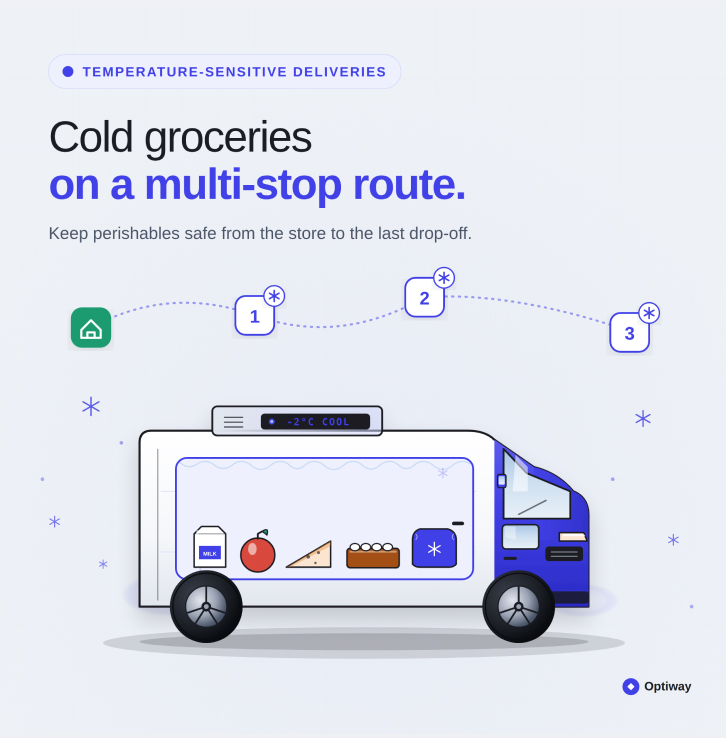
How to Keep Groceries Fresh on a Route With Multiple Stops
Milk, meat, frozen items, and too many stops can ruin a run fast. Optiway helps shape cleaner grocery routes so freshness lasts with less backtracking.
Delivery time windows - how to avoid late arrivals and waiting
Optiway turns delivery time windows into a route plan you can actually keep — fewer late arrivals, less waiting outside locked doors, more predictable days.
Why Google Maps Falls Short for Truck Routes
Where a navigation app stops being enough for commercial multi-stop routing.
Plan, assign and track every driver — live, from one dashboard.