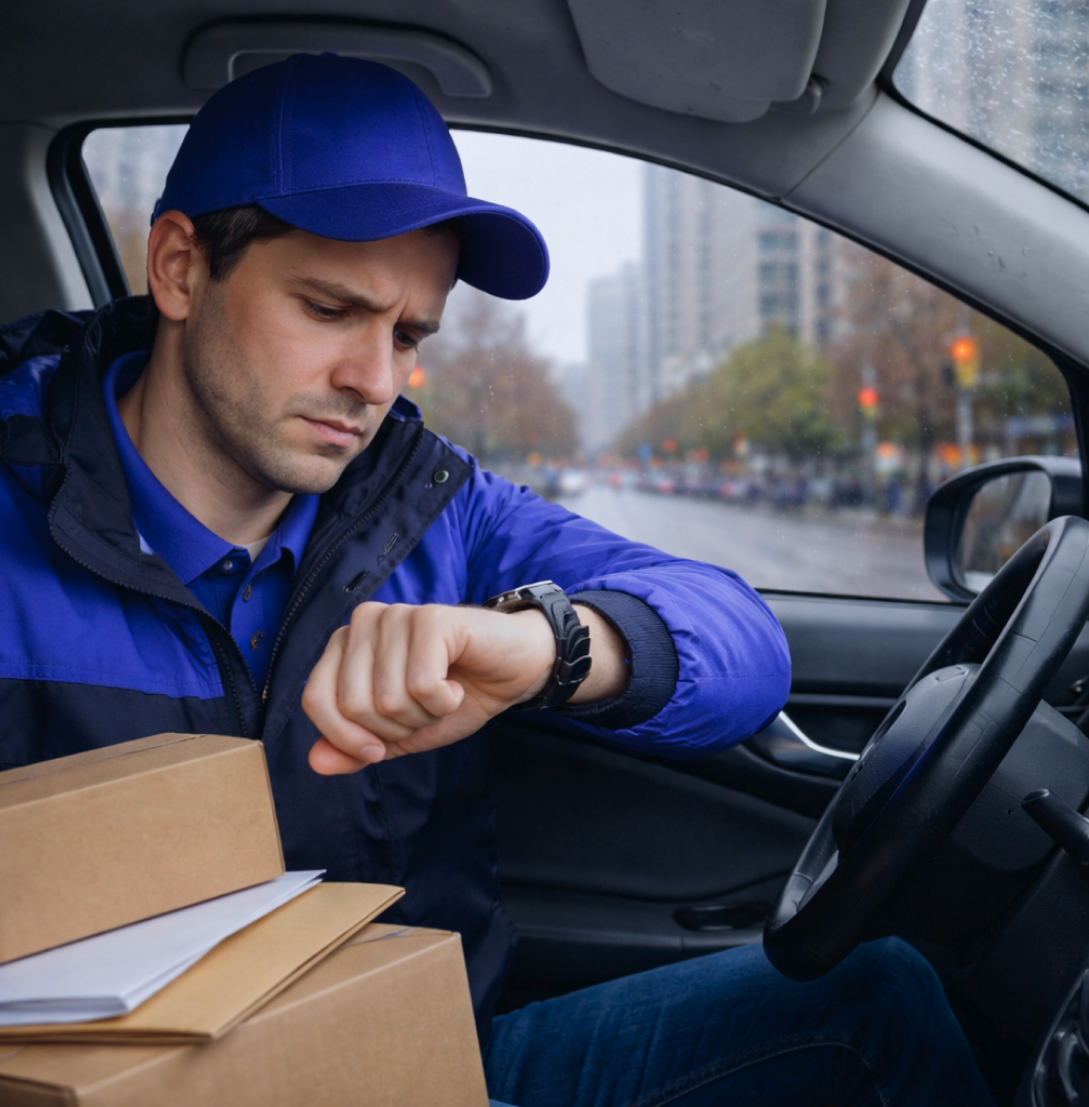
A delivery time window is a simple promise with two numbers: “We’ll be there between 2:00 and 5:00.” It exists because real life rarely cooperates with a single exact minute — traffic thickens, weather turns, the previous stop takes longer, and suddenly your “3:10 PM” becomes a guessing game.
What a delivery time window actually means
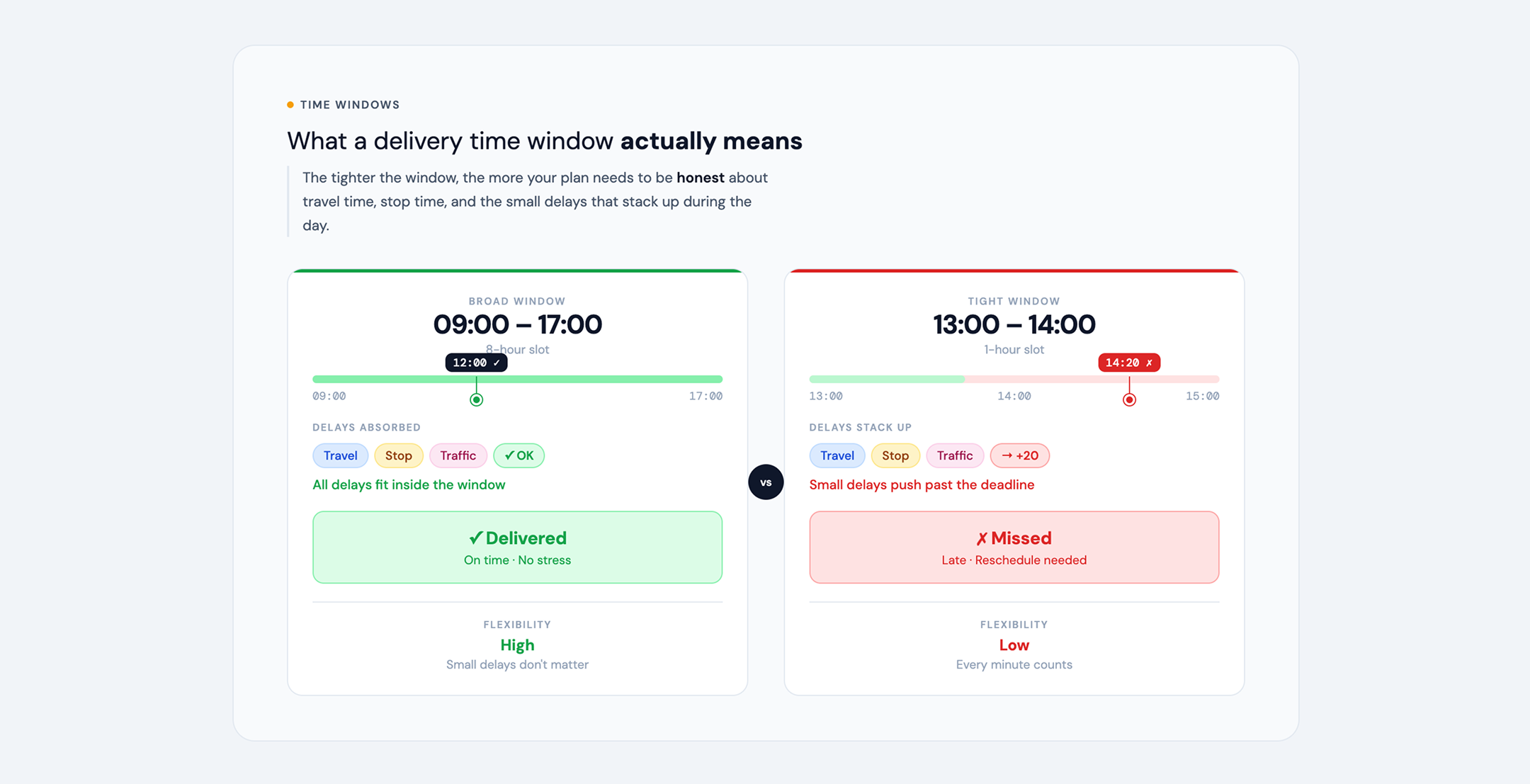
A delivery time window is the expected timeframe for a delivery to arrive. It can be broad (a few hours) or tight (a specific slot). The tighter it gets, the more your plan needs to be honest about travel time, stop time, and the small delays that stack up during the day.
Windows are useful for everyone involved. The recipient can be ready to receive the delivery, and you can plan a route that does not force you to rush, idle, or show up when nobody is available.
Why exact arrival times are hard
On paper, a route looks clean. On the road, it gets messy. Delivery windows add flexibility so a route can absorb normal disruptions without turning into a chain reaction of missed slots.
Common reasons windows slip
- Weather — rain, snow, strong wind, low visibility.
- Traffic congestion — slowdowns, bottlenecks, unpredictable flow.
- Road work — lane closures, detours, reduced speed zones.
- Stop‑to‑stop variability — parking, building access, check‑in, waiting for signatures, elevator delays.
- “One more quick thing” — the extra 3 minutes that happens at five stops in a row.
The two expensive failures: late arrivals and early arrivals
Late arrivals
Late arrivals usually come from windows that are too tight for the route reality, plus a plan that leaves no buffer. One slow stop becomes two late stops, then four. By midday, you are no longer “running behind” — you are chasing the day.
Early arrivals (the hidden time sink)
Getting there too early sounds harmless until it happens three times. A locked gate, a closed dock, a receptionist who says “come back at 11” — and you are parked, waiting, and losing the very time you needed later.
How to build delivery windows that survive the day
1) Start with windows that match how people actually receive deliveries
If the recipient is flexible, a wider window is not “worse” — it is realistic. If the recipient is strict, treat that stop as the anchor of your route and plan around it.
2) Add stop time on purpose, not as an afterthought
Travel time is only half of routing. The other half is what happens when you arrive: parking, walking, access, confirmation, and the “tiny delays” that are not tiny when repeated. Give each stop a realistic service time in your head, even if you are not formally tracking it.
3) Avoid stacking tight windows back-to-back
Two strict windows in a row leave you no breathing room. When possible, place a flexible stop between them, or plan extra buffer so one delay does not automatically break the next promise.
4) Put the strictest windows earlier when you can
The first half of the day usually has fewer accumulated delays. If you can choose, handle the most time‑sensitive stops before the route picks up “unexpected extras.”
5) Keep buffers where delays are most likely
Instead of sprinkling random buffer everywhere, place it where your route tends to slow down: dense areas, downtown parking, campuses, security check‑ins, and stops that historically run long.
How to avoid waiting without becoming late
The goal is not “as early as possible.” The goal is “inside the window, with minimal idle time.” Waiting is often caused by one of these patterns:
- You routed a nearby stop too early and arrived before the allowed start time.
- You underestimated how long it takes to get from your previous location to the destination.
- You ignored the reality of access (parking, gate codes, check‑in).
A simple fix is planning around earliest acceptable arrival, not just distance. When your plan respects the start of each window, you spend less time sitting in the car hoping a door opens.
Where Optiway fits into the workflow
Optiway is useful when your day includes multiple stops and specific “not‑before / not‑after” expectations. You can set a time window per stop and build a route order that aims to hit each window without forcing you into constant waiting or last‑minute panic.
The practical win is clarity before you start: you see planned arrival times and the stop sequence, then you drive the day with fewer surprises. If something changes, you adjust the plan and continue with a schedule that still makes sense.
A quick pre-departure checklist
- Do I have a time window for every stop that needs one?
- Did I account for “arrival‑to‑done” time, not only driving?
- Are my strict windows spaced out or buffered?
- Do my earliest arrivals make sense, or will I be forced to wait?
- Is there at least one flexible stop that can absorb delays?
Delivery windows are not bureaucracy — they are the guardrails that keep a route from turning into a day‑long apology tour. Plan them with realism, build buffers where they matter, and aim for “on time” that feels calm, not frantic.